Aller au contenu
DSD Research Library Plateforme publique de recherche
Français
  • 简体中文
  • English
  • Français
  • Русский
  • Español
  • Português
Recherche Cas cliniques Recherche Atlas Publications Formation Méthodes

Galerie de cas

Explorez les cas et les figures de la collection originale. Recherchez par affection, gène, caryotype ou phénotype et consultez la publication source.

280 Cas illustrés571 Images

Dossiers de casGalerie de cas 280
Tout

Sélection actuelle: 1 Cas illustrés · 1 Images

Sélectionnez une image pour l’agrandir. Les images originales conservent le fichier source complet.

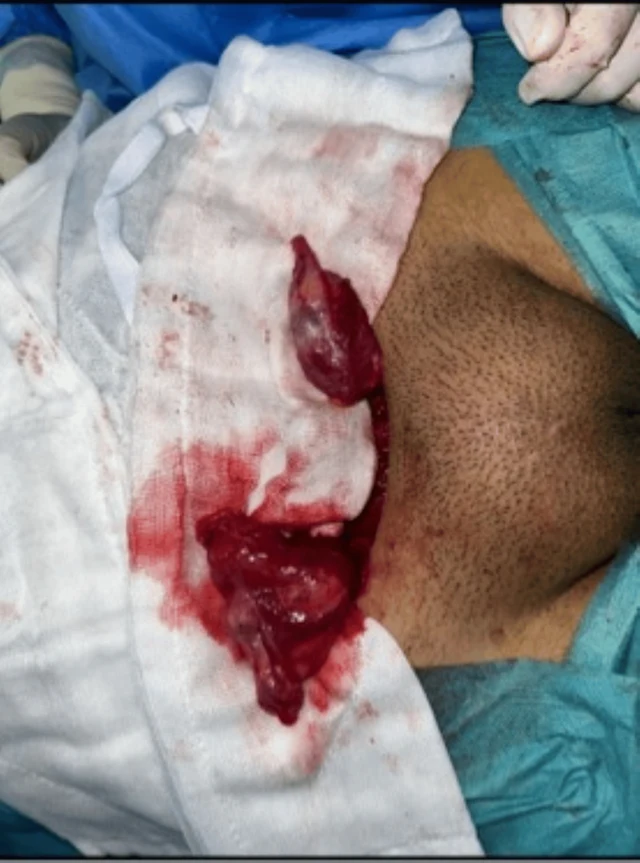
FIGURE 4: Intraoperative appearance of bilateral gonadal structures. Surgical exploration demonstrating dysgenetic gonadal tissue located in the inguinal region. Histopathological examination revealed dysgenetic testicular tissue with a limited number of medium-sized seminiferous tubules showing maturation arrest at the primary spermatocyte stage, sparse Leydig cells, and absence of ovarian parenchyma or stroma. These findings were consistent with dysgenetic testicular tissue. Management and follow-up Management was discussed in a multidisciplinary setting involving pediatric endocrinologists, pediatric surgeons, geneticists, and psychologists. Age-appropriate information was provided, and shared decision- making was conducted with the patient and her parents. The patient expressed a stable female gender identity. Bilateral orchiectomy was performed in accordance with the declared gender, with psychological support. Histological analysis of the resected gonads showed complete testicular atrophy without intratubular germ cell neoplasia or malignant features. Estrogen replacement therapy with 17β-estradiol was subsequently initiated, along with management of hyperandrogenism and regular endocrinological follow-up. 1 Images

DSD-C022

DSD 46,XY (différences du développement sexuel) · 46,XY · DSD-C022

NR5A1 · 46,XY · HPO:0000135, Hypogonadism (HP:0000135)

Les paramètres de croissance montrent une taille de 164 cm (+1.5 SD), un poids de 75 kg (>+2 SD) et un indice de masse corporelle de 28.2 kg/m², compatibles avec un surpoids selon les courbes de croissance de référence féminines.

CasPublication sourceAtlas

Balayez à gauche ou à droite pour voir les images de ce cas

Ouvrir l’image originale
CasPublication sourceAtlasVoir la légende originale en chinois
DSD Research Library Version des données v1.4.0