DSD-C033
Androgen insensitivity syndrome (AIS) · 46,XY · DSD-C033
Complete androgen insensitivity syndrome (CAIS), supported by female phenotype, 46,XY karyotype, male-range androgen levels, absent uterus and intra-abdominal testes; histopathology showed atrophic undescended testes.
Images · 2
Case fields and evidence
- Category
-
Androgen insensitivity syndrome (AIS)
- Age
-
16-year-old
- Sex
-
In 2020, a 16-year-old individual, phenotypically female with female psychosexual identity, presented at the Center for Reproductive Medicine ‘Universe’ in Tbilisi, Georgia, due to primary amenorrhea.
- Karyotype
-
46,XY
- Phenotypes
-
Primary amenorrhea (HP:0000786); Gynecomastia (HP:0000771)
- Diagnosis
-
Complete androgen insensitivity syndrome (CAIS), supported by female phenotype, 46,XY karyotype, male-range androgen levels, absent uterus and intra-abdominal testes; histopathology showed atrophic undescended testes.
- Follow-up
-
Not reported
- General phenotype
-
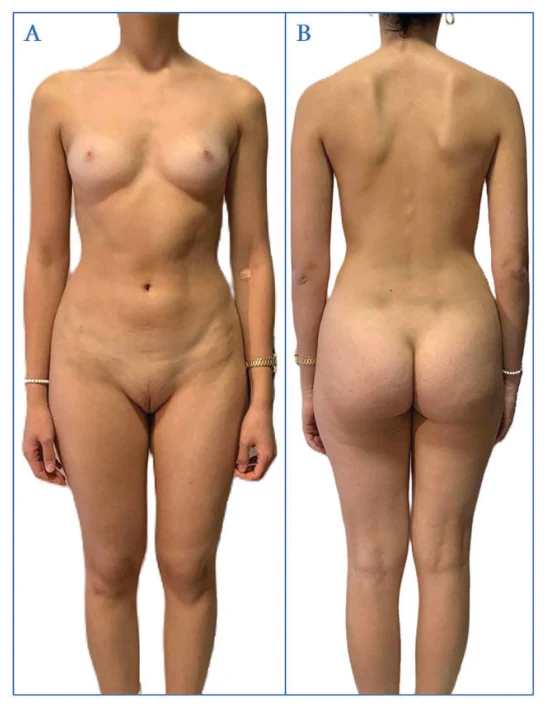
Physical examination of the patient indicated a height of 161 cm, weight of 52 kg, shoulder circumference of 92 cm, pelvic width of 91 cm, and sexual development at Tanner stage Ma3P1AX0Me0, with retracted, underdeveloped nipples, reduced and pale areolas, and sparse pubic and absent axillary hair. Subsequently, at the age of 14, the patient sought a gynecological consultation for the absence of menstruation, despite having started breast development at 13.
- Imaging
-
Ultrasonographic examination revealed uterine agenesis and identified gonadal structures, misinterpreted as ovaries. The absence of comprehensive hormonal and genetic evaluation led to an incorrect diagnosis of Mayer-Rokitansky-Ku¨ ster-Hauser (MRKH) syndrome, based solely on ultrasonography and clinical observation. Pelvic ultrasound and magnetic resonance imaging (MRI) confirmed vaginal hypoplasia and uterine agenesis, with the gonads located at the iliac fossa level (Figure 1).
- Laboratory findings
-
Not reported
- Management
-
At the age of 16, the patient underwent a comprehensive clinical evaluation, involving extensive laboratory, instrumental, and genetic assessments. The management strategy, encompassing the timing of gonadectomy and lifelong estrogen therapy, was devised after consultation with a multidisciplinary team of gynecologists, geneticists, pediatric surgeons, pediatricians, and psychotherapists. Given the relatively low oncological risk before puberty, it was decided to postpone gonadectomy until post-puberty.
- Pathology
-
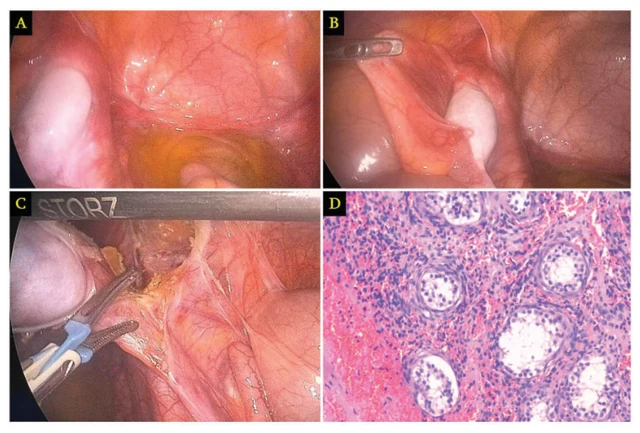
During this surgery, a gonad, initially misidentified as an ovary, was repositioned without biopsy. Histopathology confirmed the diagnosis of CAIS with the presence of atrophic, undescended testicles (Figure 3(d)).
- Evidence level
-
See source
- Clinical history
-
See source
- Family history
-
See source
- Growth and development
-
See source
- External genital examination
-
See source
- Puberty / Tanner
-
See source
- Genetics
-
See source
Cite this resource
DSD Research Library | Androgen insensitivity syndrome (AIS) · 46,XY · DSD-C033 | v1.4.0 | 2026-11-17 | https://dsdatlas.com/en/cases/DSD-C033?version=v1.4.0