DSD-C039
Other / unclassified DSD · 46,XX · DSD-C039
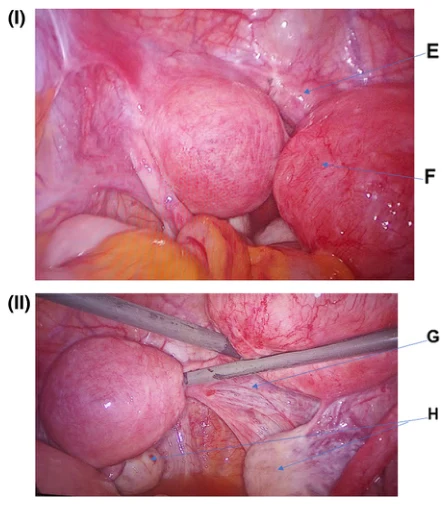
There was a blind transverse connection between the two uteruses and a horseshoe band cervix, which confirmed the diagnosis of mullerian agenesis or Mayer–Rokitansky–Kuster– Hauser (MRKH) syndrome (Fig. Hence, it was confirmed to be type 1 MRKH syndrome.
Images · 1
Case fields and evidence
- Category
-
Other / unclassified DSD
- Age
-
25-year-old
- Sex
-
She was phenotypically female with normal breast and pubic hair development (Tanner 4).
- Karyotype
-
46,XX
- Diagnosis
-
There was a blind transverse connection between the two uteruses and a horseshoe band cervix, which confirmed the diagnosis of mullerian agenesis or Mayer–Rokitansky–Kuster– Hauser (MRKH) syndrome (Fig. Hence, it was confirmed to be type 1 MRKH syndrome.
- Follow-up
-
She was started on continuous oral contraceptive pills (OCPs) and was asked to follow up in the gynecology clinic as she opted for medical treatment. She agreed to regular follow-up and to undergo surgical treatment at a later date if needed.
- General phenotype
-
Not reported
- Imaging
-
An abdominal ultrasound (US) was done, which showed the presence of blood in the right uterus and multiple small ovarian cysts. Magnetic resonance imaging (MRI) without contrast revealed a bicornuate uterus (likely a unicollis), with both horns revealing features of adenomyosis. US and MRI revealed a rare variant of MRKH syndrome, polycystic ovaries, and Fig. 1 MRI of the pelvis: A Blue arrow shows uterine cavity of one cornue of bicornuate uterus.
- Laboratory findings
-
Not reported
- Management
-
She was started on continuous oral contraceptive pills (OCPs) and was asked to follow up in the gynecology clinic as she opted for medical treatment. She was treated with analgesics and discharged with continuous OCPs as medical management.
- Pathology
-
Not reported
- Evidence level
-
See source
- Clinical history
-
See source
- Perinatal history
-
See source
- Family history
-
See source
- Growth and development
-
See source
- Puberty / Tanner
-
See source
Cite this resource
DSD Research Library | Other / unclassified DSD · 46,XX · DSD-C039 | v1.4.0 | 2026-11-17 | https://dsdatlas.com/en/cases/DSD-C039?version=v1.4.0