DSD-C113
46,XX DSD · 46,XX · DSD-C113
46,XX male / 46,XX sex reversal disorder (SRY-positive), primary hypogonadotropic hypogonadism, secondary non-functioning pituitary macroadenoma causing panhypopituitarism.
Images · 2
Case fields and evidence
- Category
-
46,XX DSD
- Age
-
75 years (at presentation; followed to 81 years, pituitary tumor resected at ~83 years)
- Sex
-
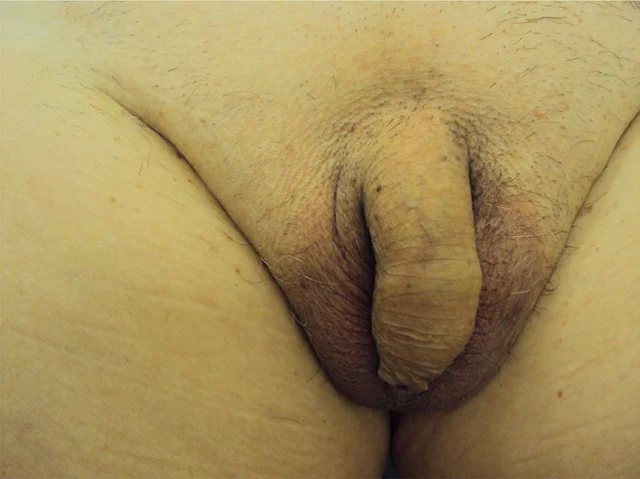
Social male, heterosexual orientation; reared as male since childhood, no gender dysphoria; no record of ambiguous genitalia at birth, but examination showed micropenis, undeveloped scrotum, and very small testes.
- Karyotype
-
46,XX
- Genetics
-
SRY
- Phenotypes
-
Hypogonadism (HP:0000135); Gynecomastia (HP:0000771)
- Diagnosis
-
46,XX male / 46,XX sex reversal disorder (SRY-positive), primary hypogonadotropic hypogonadism, secondary non-functioning pituitary macroadenoma causing panhypopituitarism.
- Follow-up
-
After treatment, weight recovered (77 to 85 kg), muscle strength recovered, returned to active life with gymnastics three times weekly, satisfied sexual life. Followed 6 years (age 81) in good general condition, pituitary lesion stable without visual field defect; surgery at ~83 years, good postoperative recovery.
- General phenotype
-
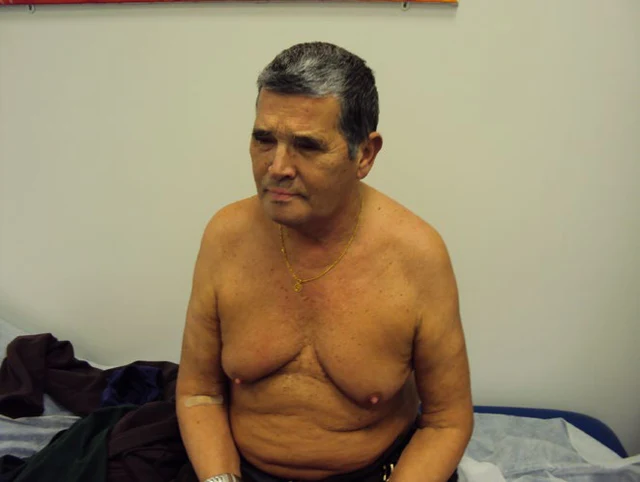
Cachexia, somnolence, confused about recent events. Sparse body hair (especially genital), scalp without temporal recession or whorl alopecia (non-male pattern). Bilateral gynecomastia (Tanner stage 3), non-tender, no galactorrhea (Fig. 1). Thyroid not palpable; heart, lung, and abdominal exams unremarkable; peripheral pulses palpable.
- Imaging
-
Cranial MRI: large sellar mass 20x20 mm, extending suprasellar, cystic, T1 hypointense T2 hyperintense, upper border contacting but not significantly compressing the optic chiasm, lower border compressing the sellar floor, not invading cavernous sinus, pituitary stalk indistinct (Fig. 3). Octreotide scan: no uptake in pituitary region. Scrotal ultrasound: bilateral small testes with heterogeneous hypoechoic pattern (Fig. 4), short epididymis, seminal vesicles not clearly visualized, small prostate (<10 cc) with calcification, no hydrocele/varicocele.
- Laboratory findings
-
Hemoglobin: low-normal normocytic normochromic anemia (timing baseline); Serum sodium: 128 mEq/L (ref 135-145; timing baseline [mild hyponatremia]); Potassium/glucose/liver-kidney/calcium-phosphorus-magnesium: normal (timing baseline); Albumin: 2.8 mg/dL (ref low-normal limit; timing baseline); Cholesterol: mildly elevated (timing baseline); PSA: <0.01 ug/L (ref very low; timing baseline); Combined pituitary stimulation test (insulin 10 IU + TRH 200 ug + LHRH 100 ug IV): hypogonadotropic hypogonadism, globally diminished pituitary axis reserve (panhypopituitarism) (timing dynamic test); Testicular tumor markers beta-hCG/AFP/CEA: negative; Bone density: lumbar T-score -1.45; femoral neck T-score -1.29 (decreased)
- Management
-
Hydrocortisone 20 mg morning + 10 mg evening; levothyroxine 100 ug at bedtime; testosterone enanthate 250 mg IM every 2 weeks. Later hydrocortisone adjusted to 15+5+5 mg. Losartan/hydrochlorothiazide 100/12.5 mg restored. Attempted long-acting somatostatin analog 20 mg IM monthly for 6 months; pituitary lesion unchanged, patient declined further treatment. At ~83 years, transsphenoidal tumor resection for headache and visual field restriction, resumed medications postoperatively.
- Pathology
-
Transsphenoidal resection of pituitary macroadenoma 1.1 g; pituitary adenoma with diffuse sinusoidal pattern; rare mitoses (<3/10), mild atypia; immunohistochemistry FSH diffusely positive, Ki67 <3% (non-functioning gonadotroph adenoma).
- Evidence level
-
See source
- Clinical history
-
See source
- Perinatal history
-
See source
- Family history
-
See source
- Growth and development
-
See source
- External genital examination
-
See source
- Puberty / Tanner
-
See source
- Limitations
-
See source
Cite this resource
DSD Research Library | 46,XX DSD · 46,XX · DSD-C113 | v1.4.0 | 2026-11-17 | https://dsdatlas.com/en/cases/DSD-C113?version=v1.4.0