DSD-C128
Gonadal dysgenesis · 46,XY · DSD-C128
46,XY gonadal dysgenesis (complete/incomplete intermediate state) — a 'late-diagnosis trap' in adulthood. Key lesson: the importance of early correct sex assignment and the profound psychosocial impact on DSD patients.
Images · 1
Case fields and evidence
- Category
-
Gonadal dysgenesis
- Age
-
21 years
- Sex
-
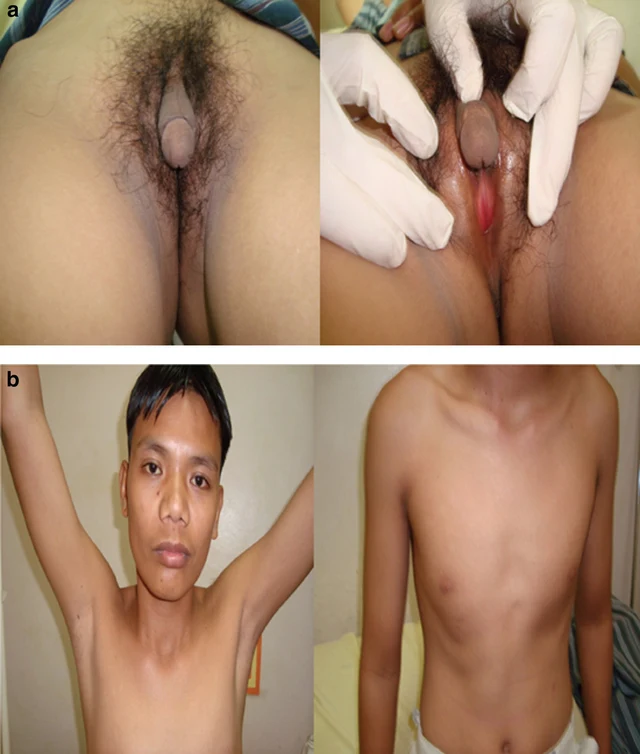
Female-appearing external genitalia with clitoromegaly at birth → registered and raised as female. From age 11, virilization signs appeared (pubic hair, penile growth) → self-identity shifted toward male. Completed a criminology degree but sought care because, due to the sex discrepancy on identity documents, he could not pass the medical exam to become a police officer.
- Karyotype
-
46,XY
- Phenotypes
-
Ambiguous genitalia (HP:0000062); Cryptorchidism (HP:0000028)
- Diagnosis
-
46,XY gonadal dysgenesis (complete/incomplete intermediate state) — a 'late-diagnosis trap' in adulthood. Key lesson: the importance of early correct sex assignment and the profound psychosocial impact on DSD patients.
- Follow-up
-
Maintained on testosterone replacement. Y-chromosome carrier has lifelong gonadal tumor risk (gonadoblastoma/germinoma 20–30%).
- General phenotype
-
Normal upper/lower body proportions. No axillary/facial hair, no breast development. Abundant pubic hair in male distribution. Phenotypically male appearance.
- Imaging
-
Whole-abdomen CT: right cryptorchidism + suspected left testicular remnant; Genitogram: blind-ending vaginal pouch 4.5 cm deep (arrow).
- Laboratory findings
-
Karyotype: 46,XY (reference: no abnormality in any cell line; time point: initial); serum testosterone: 5.4 nmol/L (reference: 9–38, low; time point: baseline); FSH: 34.3 mIU/L (reference: 1.0–10.5, markedly elevated; time point: baseline); LH: 13.8 mIU/L (reference: 1.9–9.4, elevated; time point: baseline); 17-OHP: 1.1 nmol/L (reference: <6, normal, excludes CAH; time point: baseline); DHEA: 1.1 μmol/L (reference: 2.20–15.20, low; time point: baseline); whole-abdomen CT: right cryptorchidism; suspected left pubic testicular remnant (reference: –; time point: imaging); Genitogram: blind-ending vaginal pouch depth 4.2 cm (cystoscopy)/3.5 cm (Genitogram) (reference: –; time point: endoscopy/contrast); laparoscopy: bilateral cryptorchidism confirmed (reference: –; time point: intraoperative); pathology (right testis): fibrous tissue + collapsed cystic spaces (testicular remnant) (reference: testicular dysgenesis; time point: postoperative); pathology (left testis): scant testicular tissue + sparse Sertoli cells + no sperm (reference: testicular dysgenesis syndrome; time point: postoperative)
- Management
-
Bilateral laparoscopic orchiectomy + single-stage hypospadias repair. Postoperative testosterone replacement injections. Legal sex-change procedure in progress.
- Pathology
-
Right testis: fibrous tissue + collapsed cystic spaces representing testicular remnant. Left testis: scant testicular tissue composed mainly of Sertoli cells in seminiferous tubules, no sperm identified. Consistent with testicular dysgenesis.
- Evidence level
-
See source
- Clinical history
-
See source
- Perinatal history
-
See source
- Family history
-
See source
- Growth and development
-
See source
- External genital examination
-
See source
- Puberty / Tanner
-
See source
- Genetics
-
See source
Cite this resource
DSD Research Library | Gonadal dysgenesis · 46,XY · DSD-C128 | v1.4.0 | 2026-11-17 | https://dsdatlas.com/en/cases/DSD-C128?version=v1.4.0